VitaDX has developed an innovative, sensitive, and reproducible solution for the diagnosis and follow-up of bladder cancer called VisioCyt® Bladder, performed from a simple urine sample.
Talk to your urologist about it!
Are you a caregiver or patient? Step out of isolation and connect with the patient association Cancer Vessie France
people diagnosed and treated each year worldwide (1)
0th
cancer type with 16,282 cases per year in France (1,2)
Bladder cancer affects men in 80% of cases (1). The average age at diagnosis is 70 years (2).
The main symptoms are hematuria and bladder irritation (1).
People at risk include smokers and professionals exposed to chemicals in various industrial sectors (3).
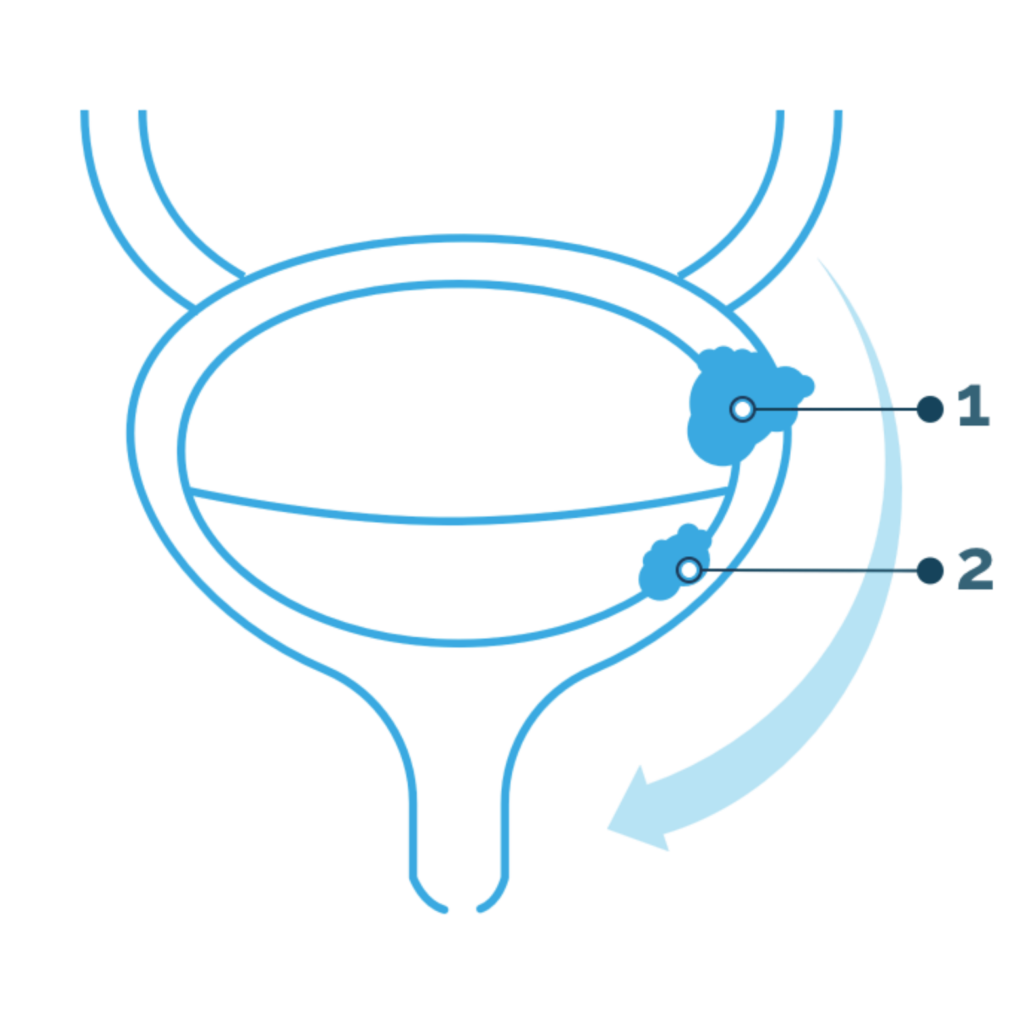
Types of bladder tumors at diagnosis
Muscle-Invasive Bladder Tumor (MIBT)
They are more aggressive and require more intensive management: chemotherapy, cystectomy, radiotherapy, etc.
5-year survival rate: 50%
Non–Muscle-Invasive Bladder Tumor (NMIBT)
They account for the majority of bladder cancers and often have a risk of recurrence, requiring regular follow-up.
5-year survival rate: 80%; 50% experience recurrence, of which 15% progress to muscle-invasive bladder cancer (MIBT).
All you need to know
The care pathway
If bladder cancer is suspected, your urologist will carry out the necessary tests and investigations to establish an accurate diagnosis.
Urinary tract ultrasound
Urinary tract ultrasound is primarily performed as part of a hematuria workup to detect possible bladder abnormalities. However, it cannot rule out the diagnosis and usually prompts further evaluation through endoscopy (1).
Urine cytology
Urine cytology is the reference test for the detection and monitoring of high-grade non–muscle-invasive bladder tumors (NMIBT). However, it has low sensitivity for low-grade tumors. Therefore, a negative cytology result does not rule out the presence of a tumor (1).
Cystoscopy
Cystoscopy has several objectives:
Establish a diagnosis when ultrasound is negative but bladder tumor is suspected.
Determine the number, size, location, and appearance of the tumor and the bladder mucosa.
Resect a bladder tumor (1).
Histological analysis
Histological analysis allows the identification of the cellular grade and tumor stage of the bladder tumor based on the 2016 WHO classification. These are the two fundamental criteria for subsequent management (1).
SOLUTION
VisioCyt® Bladder
VisioCyt® Bladder – a non-invasive, sensitive, and reproducible test performed alongside cytology and prior to cystoscopy – enables your urologist to personalize and adjust your care based on the results (e.g., urgency of cystoscopy, guidance of endoscopic practice, additional tests…).
Although VisioCyt® Bladder represents a significant advance in the diagnosis and follow-up of bladder cancer due to its sensitivity, it does not guarantee 100% detection of a potential cancer or recurrence. Based on VisioCyt® Bladder results, your urologist may recommend additional tests.
Advice & collection laboratories
Do you have a prescription?
Find all the information you need to properly carry out your test.
Discover how the VisioCyt® Bladder test works and explore testimonials from patients, physicians, and experts on the diagnosis and management of bladder cancer.
VisioCyt® Bladder (BASIC UDI-DI: 377002199701AM) is a CE IVDR Class C in vitro diagnostic medical device (Notified Body: BSI No. 02797 / Manufacturer: VitaDX International). This IVD medical device, intended for healthcare professionals, is designed to facilitate and improve the diagnosis of urothelial carcinoma of the bladder by detecting tumor cells on digitized urinary cytology slides. The tool aims to predict the presence or absence of bladder cancer, whether it is a low-grade or high-grade tumor. Please read the instructions for use carefully. The analysis is not reimbursed by the national health insurance system. No residual risks or adverse effects have been identified. The performances of VisioCyt® Bladder are the following: Mean Sensitivity: 80.9 % / Sensitivity on High-Grade cancer: 93.7 % / Sensitivity on Low-Grade cancer: 66.7 % / Specificity: 61.8 %
This website is intended for healthcare professionals.
The information and content presented are not intended for the general public.
If you are not a healthcare professional, we invite you to visit the public information website.